Turkey is striving to make the transition to electricity a key focus in the negotiations at the United Nations climate change conference "COP31," which will be hosted in Antalya from November 9 to 20. This shift comes amid the energy crisis caused by the war in the Middle East, which has revealed the extent of countries' dependence on fossil fuels, pushing the issue of diversifying energy sources to the forefront of international discussions.
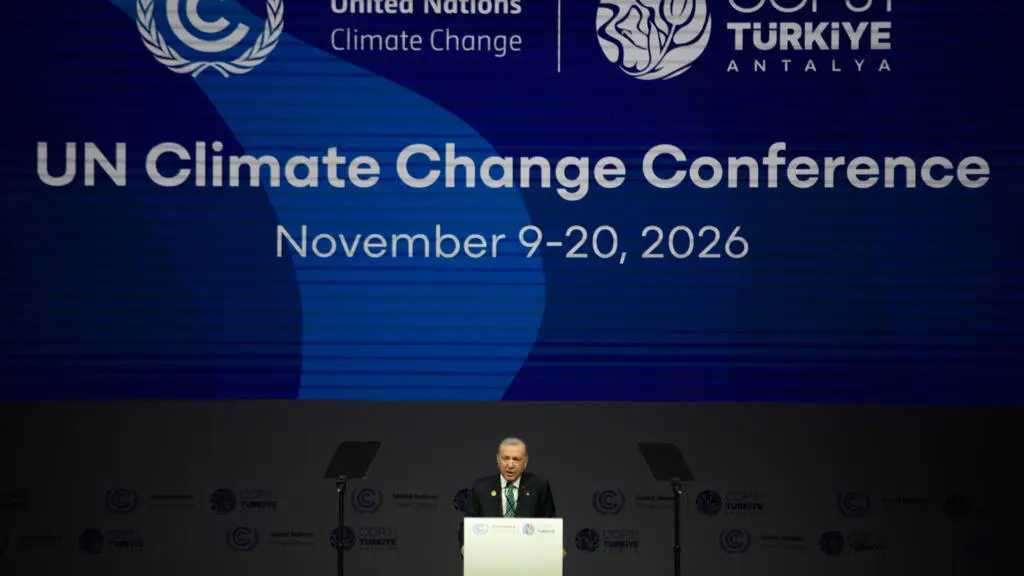
Attention is turning towards climate issues with the launch of the 31st session of the United Nations conference on this topic "COP31," which began on Monday, November 9, and will continue until the 20th of the same month, in the Turkish city of Antalya, with the participation of countries from around the world.
This year's conference is held against a backdrop of rising geopolitical tensions and after a summer marked by a series of natural disasters, amid growing concerns about the future of climate. The goal of the Paris Agreement of 2015, which aims to limit global warming to 1.5 degrees Celsius, appears to be out of reach. The United Nations warned in its annual report issued on October 21 that global warming could reach 2.8 degrees Celsius by 2100 if current policies remain unchanged, compared to 2.6 degrees if current international efforts continue.
Renewable energy is gaining ground, and carbon emissions are recording a new decline.

The energy crisis heightens awareness of the importance of energy independence.
However, the current international conditions give climate advocates a reason for optimism. Gaia Faver, head of international policy at the Climate Action Network, says, "This conference is the first since the situation in the Strait of Hormuz caused an unprecedented global energy crisis." She adds, "Leaders and citizens around the world have witnessed a sharp rise in fuel prices, leading to increased awareness of the extent of dependence on fossil fuels."
During previous climate conferences, countries failed to reach an agreement on addressing the primary cause of global warming, which is fossil fuels, including gas, coal, and oil. Although participants at the "COP28" conference in Dubai in 2023 succeeded, after arduous negotiations, in agreeing on the necessity to begin "the transition away from fossil fuels," discussions about implementing this commitment have not made substantial progress since then. The "COP30" conference last year also concluded without any reference to this issue in the final agreement text.
Faver emphasizes that "this date represents a favorable opportunity to push for reducing dependence on fossil fuels and accelerating the energy transition by developing renewable energy sources." She adds that "there is consensus between issues of energy sovereignty and climate ambitions."
In an attempt to leverage this momentum, Australia and Turkey, which co-chair the "COP31" conference, decided to highlight an alternative represented by electricity. During preparatory talks held in Bonn, Germany, last June, the two countries proposed setting a target to raise the share of electricity to 35 percent of total final energy consumption by 2035. The initiative has already been named "35-35."
Turkish Environment Minister Murat Kurum confirmed that expanding reliance on electricity in cities, industry, and various aspects of life represents "the most important pillar for reducing emissions" and helps achieve the goals of the Paris Climate Agreement.
For his part, Australian Minister for Energy and Climate Change Chris Bowen stated that "no one can impose sanctions on the sun or prevent the winds from blowing," adding that solar energy does not need to pass through the Strait of Hormuz, referring to the closure of this vital passage for fuel supplies from the Middle East to the rest of the world.
On Tuesday, November 10, during "COP31," which was designated as the day for energy and transport, discussions were held regarding expanding the reliance on electricity and achieving the "35 by 35" objective, which several countries, including Germany, Australia, Norway, and Ethiopia, have announced their support for. Turkey is seeking to garner broader support to include this target in the conference's final agreement.
According to Gaia Faver, "Turkey also seeks to incorporate this objective into the official negotiations and embed it in the final agreement," which requires consensus among participating countries since conference decisions are made by unanimity.
Antalya, Turkey hosts the climate summit "COP31" ... from commitments to testing implementation.
Expanding electricity usage
Gareth Redmond-King, an international official at the British organization “Energy and Climate Intelligence Unit,” points to the "growing share of electricity in the global energy mix in recent years," reaching 23 percent of total final energy consumption by the end of 2024, according to data from the International Energy Agency.
According to the expert, Japan leads this shift with a share of 35 percent, followed by China with about 30 percent, compared to 23 percent in the European Union and 22 percent in the United States. France, which recently announced an extensive plan to expand electricity usage, has a share of around 27 percent.
But can the goal of raising the global share of electricity to 35 percent by 2035 be achieved? And will this have a real impact on combating climate change?
According to an analysis by the "Climate Action Tracker," the share of electricity in global consumption will reach 28 percent by 2035 if current policies continue, as the transportation sector lags behind in keeping up with the transition.
Gareth Redmond-King believes that this target is achievable, but "it requires political will and government investments," pointing out the rapid expansion in electricity technologies, especially driven by China, the spread of electric vehicles, and heat pumps, alongside more industries transitioning to electricity due to its lower cost compared to fossil fuels.
For her part, Gaia Faver emphasizes that "achieving a just energy transition requires support from developed countries to southern nations, alongside private sector involvement."
"Clean" or "Green" Electricity? A dispute over energy sources
The experts believe that the impact of expanding electricity usage on combating climate change will depend on the ambition of the countries. Gaia Faver asserts that the 35 percent target should be a minimum threshold, not a ceiling for ambitions.
The anticipated disagreement in "COP31" negotiations will focus on the sources of electricity production, between proponents of "clean" energy, which includes renewables and nuclear, and advocates of "green" energy, which is limited to renewable sources, and countries wishing to retain fossil fuels.
Gareth Redmond-King stresses the necessity for the expansion of electricity usage to be accompanied by a reduction in carbon emissions resulting from its production.
It is likely that India and oil-producing African countries will oppose the requirement to use "clean" or "green" electricity, while the European Union pushes for low-emission sources, including nuclear energy.
The Turkish proposal calls for "increasing the share of electricity to limit global warming to 1.5 degrees Celsius, while simultaneously developing renewable energy sources and improving energy efficiency, without requiring electricity production from emission-free sources, allowing for its expansion using various sources."
This approach reflects Turkey's energy model, as the share of clean sources in electricity production reached a record level of 43 percent in 2025, with 22 percent from solar and wind and 16 percent from hydropower, according to the research center "Ember." However, Turkey continues to build coal-fired power plants without officially setting a date to phase out fossil fuels, historically linked to a coal agreement with Australia, its partner in co-chairing the "COP31" conference.
Rationalizing energy consumption
Alongside electricity production sources, the volume of energy produced is highlighted, according to Gaia Faver. In 2025, electricity production from renewable sources surpassed that from coal for the first time, but fossil fuel energy production also increased.
This occurs amid rising energy demand to power air conditioning and heating systems due to extreme weather phenomena, in addition to data centers necessary for developing artificial intelligence.
Faver stresses the need to put a concrete plan in place to rationalize energy consumption, so that clean sources replace fossil fuels rather than adding to existing energy sources.
Amid expectations of challenging negotiations, she confirms that the biggest challenge, even in the case of reaching an ambitious agreement regarding the expansion of electricity usage, will remain the fair implementation of commitments that considers local circumstances and the difficulties faced by different countries.