- A historic bracelet encrusted with a blue sapphire, associated with the jewelry of the imperial Romanov family in Russia, achieved nearly 4.9 million dollars at an auction held by Sotheby's in the Swiss capital, Geneva, significantly exceeding the highest estimates prior to its presentation.
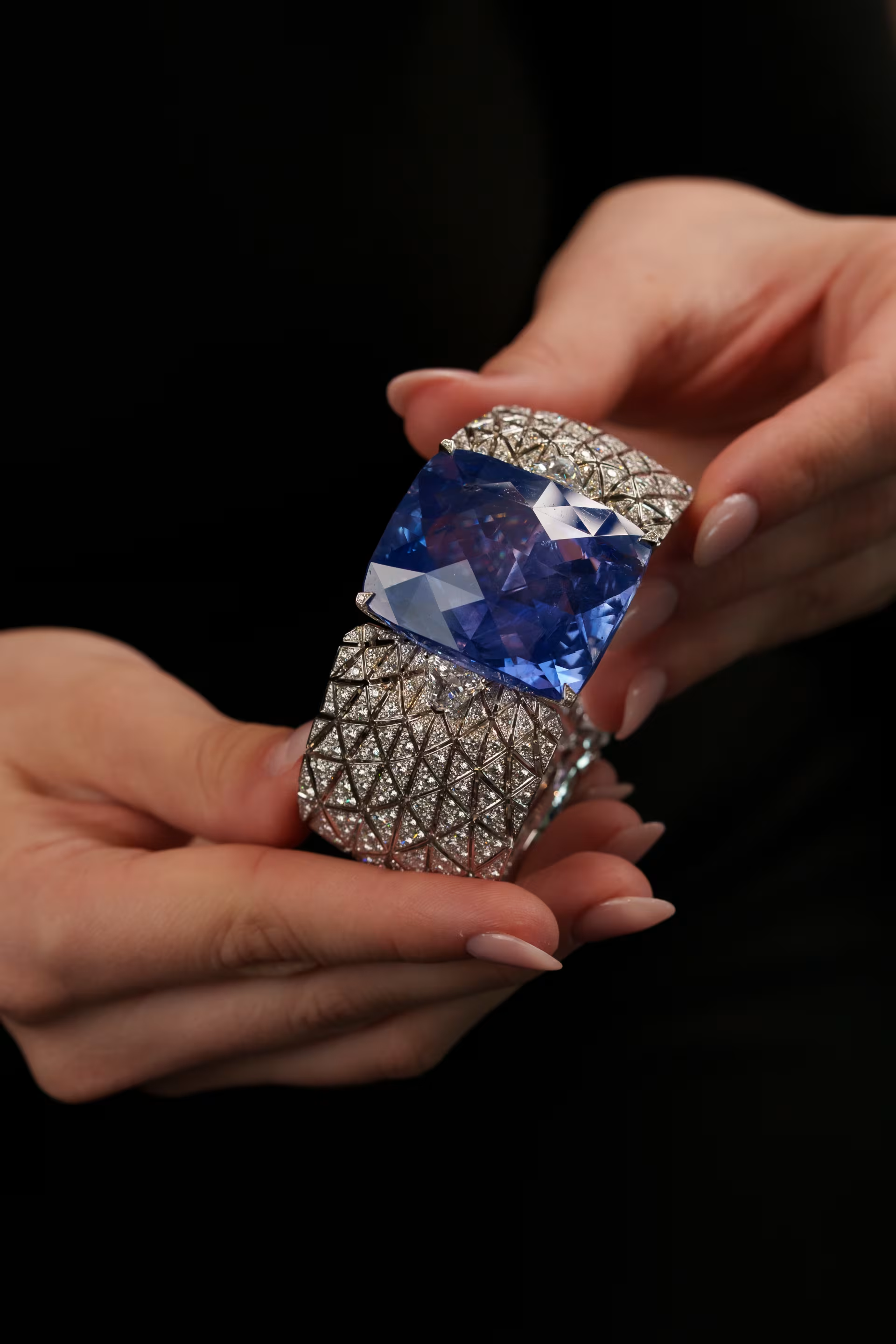
At the center of the bracelet is a blue sapphire weighing 197.80 carats, surrounded by geometric diamond-encrusted details designed by the French house Cartier. The initial estimates of its value ranged from 1.02 million to 2.04 million dollars.
Sotheby's described it as an exceptional sapphire from the Romanov collection, noting that the possessions of the Russian tsars are among the most prominent and valuable royal collections.
Significant historical value
The importance of the stone is attributed to its connection to the history of the family that ruled Russia for over three centuries, being the last imperial family to ascend the Russian throne until their reign ended in 1917.
It is not precisely known when the sapphire entered the Romanov collection, but it appeared in a historical image next to a similar stone set on the front of a gown worn by Russian Empress Maria Feodorovna during a ball in 1883, according to auction data.
After the Russian Revolution, Soviet authorities began selling the family's possessions during the 1920s. In 1927, the ownership of the stone passed to a Russian socialite named Jana Valska, and it was then set in a necklace, later reconfigured into a shorter necklace, before being sold along with Valska's belongings in 1971.
In 2015, Cartier redesigned the piece, securing the sapphire in the bracelet in its current form, which includes a central interchangeable crystal rock section. The design combines the historical value of the stone with the geometric features associated with Art Deco style.
This was not the first sale of jewelry linked to the Romanov family at Sotheby's; in 2021, a brooch set with sapphires and diamonds, along with matching earrings, was sold for 883,600 dollars, nearly doubling the previous high estimates.