A 15-year-old boy lost one of his hands while picking up a bomb fired by the police, as students across the French Republic continued to demand improved study conditions on Monday, in an ongoing wave of protests that has lasted for days, witnessing arson and the establishment of barricades at some schools, as well as the disruption of lessons in hundreds of educational institutions.
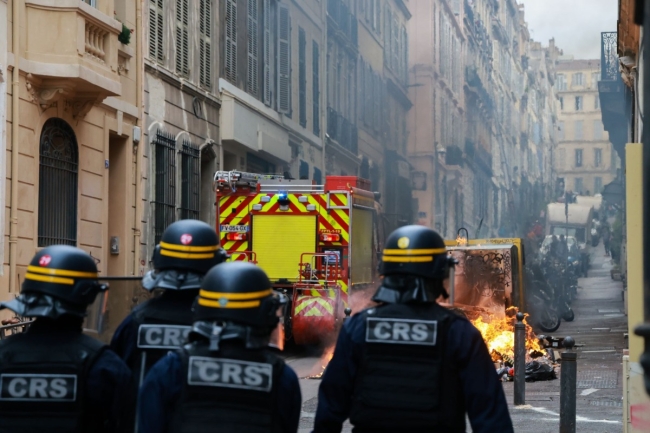
On the eve of another day of high school students' movements joined by unions on Tuesday, anger remained high on Monday with hundreds of educational institutions closed and several incidents occurring.
Among the 3,700 high schools in the country attended by students aged 15 to 18, the number of institutions affected by the protests decreased to "589," compared to "about 800" during the protests on Friday, according to the Ministry of Education.
The incidents were generally less severe than those recorded over the past weekend. However, on Monday, a 15-year-old boy in Lens in the north of the country had his hand amputated during a demonstration, according to the governor.
Education Minister Édouard Geffray described the incident as "tragic on a human level," adding that he did not know the circumstances surrounding it.
He reported that 190 students have been injured since the protests began, "most of them due to accidental incidents."
Several unions and associations accused the government of "suppressing" high school students' movements with "disproportionate" violence to silence their "legitimate" demands.
The police oversight body is conducting six investigations.
In early September, the international "PISA" study, which assesses the performance of educational systems through the skills of 15-year-old students, showed the lowest results for France since measurements began in 2000, but it remains within the average of OECD countries.
Thousands arrested
The protests began on September 17 at the Saint-Exupéry High School in the Créteil suburb in southeast Paris, in support of teachers who went on strike to protest staff shortages and resource issues.
The movement gradually gained momentum before spreading across France, marked by acts of vandalism and clashes with the police.
Since late September, students have been blocking the entrances to their schools in protest against ongoing teacher absences, long school hours, unsuitable classroom conditions, high temperatures inside, as well as other complaints.
The government has tried to respond to the protesters' demands, while at the same time accusing radical left activists of exploiting the protests.
Regarding the violence, a 17-year-old high school student in Bordeaux who preferred to remain anonymous said, "It's not the high school students who are actually doing this; it's outsiders who come to vandalize, which undermines the credibility of the movement."
Alma, a student at Charlemagne High School in central Paris, told AFP, "It's clear that the education system isn't working as it should."
Simon, also a student at Charlemagne High School, said, "They think we will stop blocking the entrances and being angry just because they let us express ourselves on an online platform, but this anger has been building for years."
The French Human Rights League accused security forces on Monday of using disproportionate methods against protesters, many of whom are legal minors.
The league's president, Nathalie Thiu, said, "We see that the instructions given to the police do not include any guidance on restraint, even though they are dealing with children."
On Monday morning, dozens of protesting students gathered in the third district in central Paris, and some cars honked in support of them, while other students were heading to their classrooms.
One protester held a placard that read, "No resources, no silence," while another placard stated, "We are skipping our classes to teach you a lesson."
In Rennes in western France, more than 20 students gathered outside "Montaine High School," with one holding a placard that read, "The number of teachers is insufficient," as the teaching staff allowed a number of students to head to their classes.
In Lille in the north, masked protesters smashed bus stops and set fire to garbage containers, while police fired tear gas in an attempt to disperse hundreds of them.
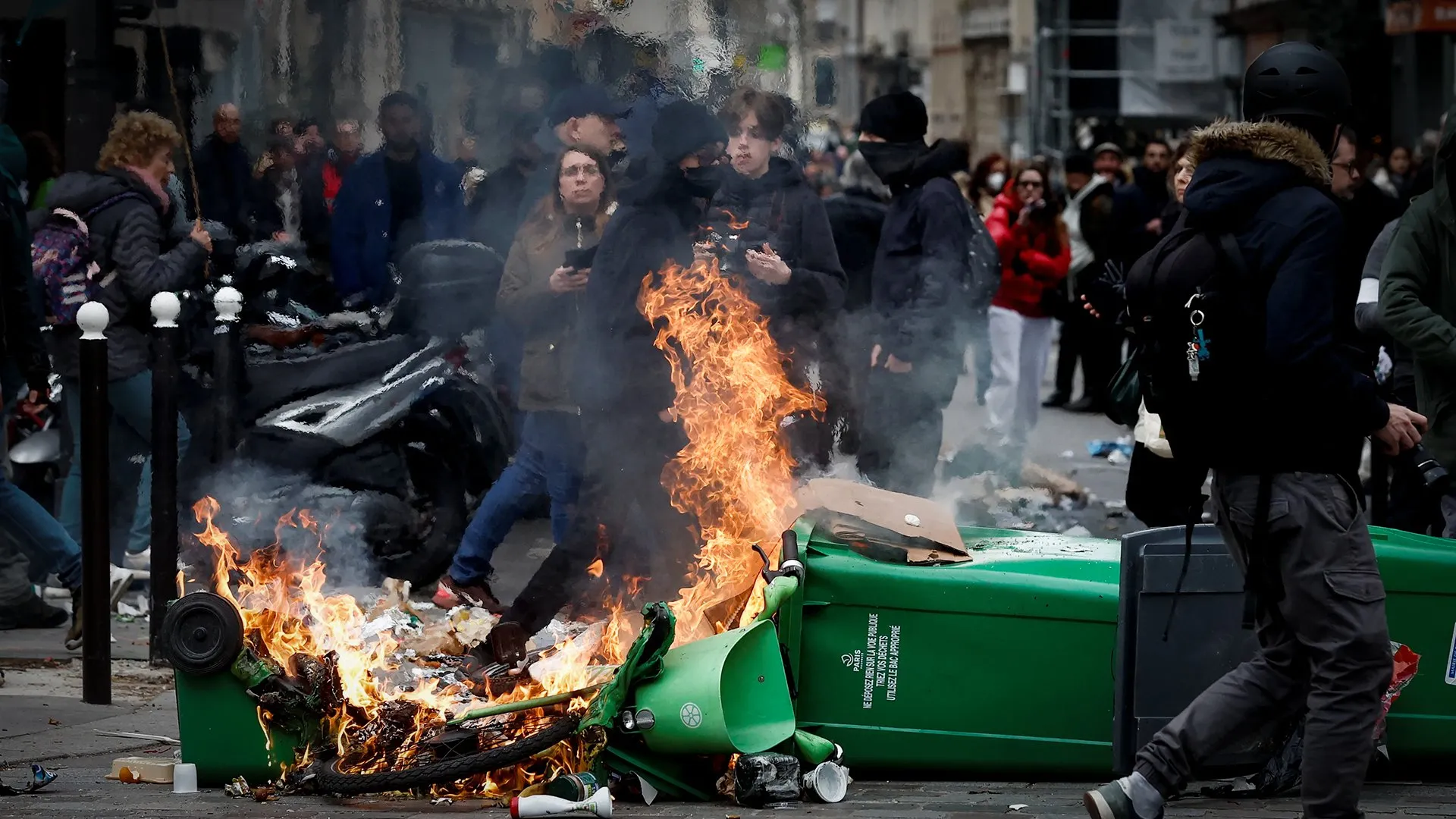
According to the French Minister of Education, 24 educational institutions were "burned or vandalized" in connection with the student protests that began earlier in the week.
French authorities have arrested more than 5,000 people, 85 percent of whom are minors.
Protesters have accused the police of using excessive violence, and an investigation has been opened into three incidents suspected of involving police violence.
Prime Minister Sébastien Lecornu urged local authorities on Sunday to prioritize addressing gaps caused by long-term teacher absences and staffing shortages, within a defined timeline.
He also called for a meeting on Tuesday with regional leaders to discuss the process of rehabilitating the largely dilapidated school buildings.
The government is also considering passing a bill in parliament that would hold parties responsible for damage to public property accountable for covering repair costs, rather than deducting them from taxpayers' money.
Government spokeswoman Maud Bréjon defended the bill, stating in an interview with "Europe 1"/"CNews," "When children aged 14, 15, or 16 set fire at nine in the morning to bus stations or perhaps, more dangerously, to the high school they attend, it raises questions about parental responsibility."
Lecornu stated that the proposed bill, first put forward before the recent protests, allows "these amounts to be deducted from family and housing allowances, while ensuring that these families retain a minimum income."
Meanwhile, the president of the General Confederation of Labor, Sophie Binet, criticized what she described as a "populist decision," warning that "the most affected will be the poorest families."