EXECUTIVE SUMMARY
Located in modern-day Dhi Qar Governorate in southern Iraq, Ur of the
Chaldees (Ur Kaśdim) stands as one of the most prominent urban centers of ancient
Mesopotamia. Flourishing during the 3rd millennium BCE under the Sumerians and
later under the Neo-Babylonian (Chaldean) Empire, the site represents a
critical juncture in early urbanization, monumental architecture, and religious
tradition. Most famously recognized in biblical historiography as the
birthplace of the patriarch Abraham, Ur remains a focal point for Near Eastern
archaeology and cultural heritage studies.
HISTORICAL AND GEOGRAPHICAL DEVELOPMENT
* Sumerian Genesis (3rd
Millennium BCE): Ur emerged as a major coastal city-state near the mouth of the
Euphrates River (which has since shifted course). During the Third Dynasty of
Ur (Ur III period, c. 2112–2004 BCE), King Ur-Nammu transformed the city into a
bureaucratic and cultural powerhouse, introducing the Code of Ur-Nammu—one of
humanity's earliest surviving legal texts.
* The Chaldean Era (1st
Millennium BCE): The designation "Ur of the Chaldees" directly
references the Neo-Babylonian period (c. 626–539 BCE), during which the
Chaldean dynasty, led by figures like Nebuchadnezzar II, renovated and
revitalized ancient Mesopotamian sites to reinforce their political legitimacy
through historical continuity.
* Desolation and Rediscovery:
Natural shifts in river systems and agricultural salinization eventually led to
Ur's abandonment around 450 BCE. The site lay buried until 19th-century
excavations brought its monuments back to light.
KEY ARCHAEOLOGICAL DISCOVERIES
Monument - Artifact ( Period ): Historical Significance.
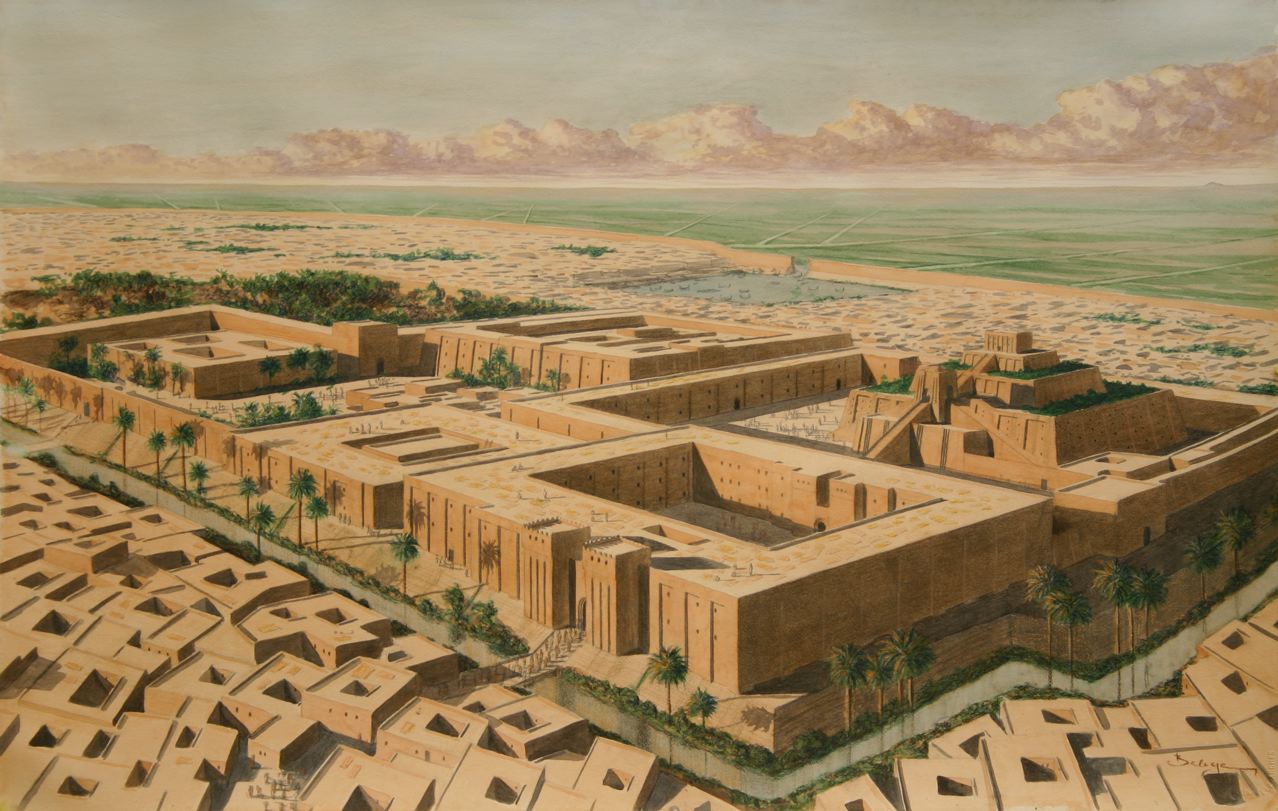
Great Ziggurat of Ur - Ur III
Period (c. 2100 BCE): A massive step
pyramid built by King Ur-Nammu, dedicated to the moon deity Nanna/Sīn; serves
as one of the best-preserved architectural feats of antiquity.
Royal Tombs of Ur - Early Dynastic III (c. 2600–2400 BCE): Excavated by Sir Leonard Woolley in the 1920s;
uncovered unlooted royal graves featuring immense wealth, gold jewelry,
weaponry, and evidence of elite burial rituals.
Standard of Ur - Early Dynastic III (c. 2500 BCE): A hollow wooden box displaying intricate
mosaic scenes of shell, red limestone, and lapis lazuli, depicting
"War" and "Peace" in Sumerian society.
HISTORIOGRAPHY AND BIBLICAL CONNECTION
The linkage between Ur and the biblical patriarch Abraham stems from the
Book of Genesis, which designates the site as the starting point of his
migration toward Canaan.
"Terah took his son Abram, his grandson Lot... and his
daughter-in-law Sarai... and together they set out from Ur of the Chaldees to
go to Canaan."
Genesis 11:31
Modern scholars note an intentional historical layer in this
designation: while the physical site existed thousands of years prior, the
explicit descriptor "of the Chaldees" reflects the editorial updates
made by writers during or after the Babylonian Exile, identifying the city by
the rulers of their own contemporary era.
HERITAGE PRESERVATION AND CURRENT STATUS
In 2016, UNESCO inscribed The Ahwar of Southern Iraq: Refuge of
Biodiversity and the Relict Landscape of the Mesopotamian Cities onto the World
Heritage List, explicitly including the archaeological ruins of Ur. Ongoing
conservation efforts focus on site preservation, mitigating environmental
erosion, and facilitating international scholarly research to safeguard this
cradle of human civilization.