EXECUTIVE SUMMARY
BAQUBAH / HILLAH — Spanning over four millennia of recorded human history, the archaeological site of Babylon stands as one of the most prominent cradles of urban civilization. Situated approximately 85 kilometers south of Baghdad along the Euphrates River, the ancient metropolis represents the pinnacle of Mesopotamian engineering, architecture, and legal development. However, modern conflict, ill-conceived reconstruction, and environmental pressures have left this historic site in a fragile state, prompting continuous international intervention.
HISTORICAL AND ARCHAEOLOGICAL SIGNIFICANCE
Babylon’s contribution to global heritage extends far beyond its physical structures:
* The Cradle of Law and Science: Under King Hammurabi (1792–1750 BCE), the city became the administrative hub for one of humanity’s earliest legal systems, the Code of Hammurabi. Later Neo-Babylonian scholars pioneered foundational advances in mathematics, astronomy, and urban planning.
* Architectural Marvels: At its height under Nebuchadnezzar II (605–562 BCE), Babylon featured iconic monuments including the Ishtar Gate, the Etemenanki ziggurat (associated with the Tower of Babel), and the legendary Hanging Gardens.
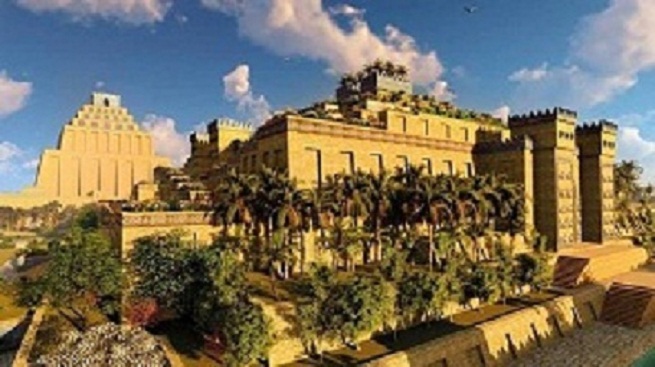

The legendary Hanging Gardens of Babel
* Unexcavated Potential: Archaeological surveys confirm that roughly 82% to 85% of the 10-square-kilometer site remains unexcavated, leaving vast fields of historical data beneath the surface.
CENTURY OF DESTRUCTION AND THREATS
The modern preservation status of Babylon reflects a series of severe anthropogenic and environmental damages:
1. Intrusive Reconstruction (1980s)
During the regime of Saddam Hussein, large-scale restoration projects were initiated without scientific conservation standards. Modern yellow bricks inscribed with political slogans were laid directly over 2,600-year-old mudbrick walls, causing permanent structural imbalance and chemical degradation due to modern cement mixtures.
2. Military Encroachment (2003–2004)
Following the 2003 invasion, international military forces established "Camp Alpha" directly on the ruins. Subsequent evaluations by the British Museum and UNESCO documented extensive site damage, including subsoil compaction caused by heavy armor, the digging of military trenches through unexcavated strata, and the widespread filling of sandbags with earth containing micro-artifacts.
3. Environmental and Urban Pressures
The site faces systemic threats from rising water tables loaded with high salinity, causing crystallization and spalling inside ancient mudbrick masonry. Uncontrolled suburban expansion from nearby Hillah poses an ongoing risk of encroachment on outer boundary zones.
CONSERVATION EFFORTS AND UNESCO INSCRIPTION
After three decades of diplomatic and technical lobbying, UNESCO officially inscribed Babylon onto the World Heritage List in 2019. The decision recognized the site's unique global value while highlighting its extreme vulnerability.
Key International Initiatives
The Future of Babylon Project: A joint initiative between the World Monuments Fund (WMF) and Iraq’s State Board of Antiquities and Heritage (SBAH). Focuses on stabilization, structural drainage, and precise 3D documentation.
Structural Stabilization: Priority interventions have stabilized key monuments, including the iconic Lion of Babylon basalt statue and the Ninmakh Temple.
Capacity Building: Technical programs continue to train local Iraqi engineers and conservators in non-destructive brick restoration and groundwater management.